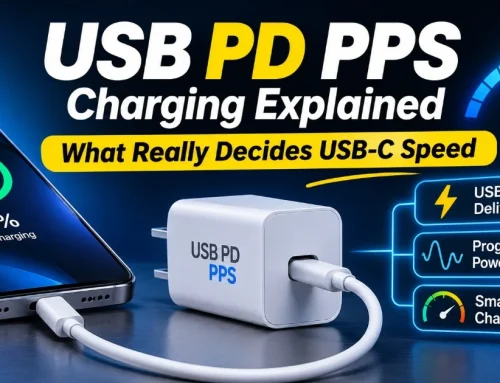
USB PD vs PPS Charging What Changes for iPhone, Samsung, and Pixel Phones

USB PD vs PPS charging is not a competition between two separate charging standards. USB PD provides fixed-voltage fast charging, while PPS adds finer voltage and current control for compatible devices, which can help some Samsung and Google phones reach their fastest charging speeds.
For most iPhones, iPads and MacBooks, standard USB PD is enough for fast charging. Samsung Galaxy and many Google Pixel phones can benefit from PPS, especially when you want their top charging mode. The practical difference is simple: PD handles the main power negotiation, while PPS lets a compatible phone request a more precise power level during charging.
Quick Highlights
Introduction
The useful detail is simple: iPhones, iPads and MacBooks fast-charge on fixed PD, while many Samsung and Google phones need PPS for their fastest mode.
That makes this less like a standards comparison and more like a compatibility check: one charger can work for everyone, but not every charger gives every phone its top speed. So, if you’ve ever wondered why one cable seems fine for everything except your newer Android phone, that’s where the story starts.
What USB Power Delivery does before PPS enters the picture
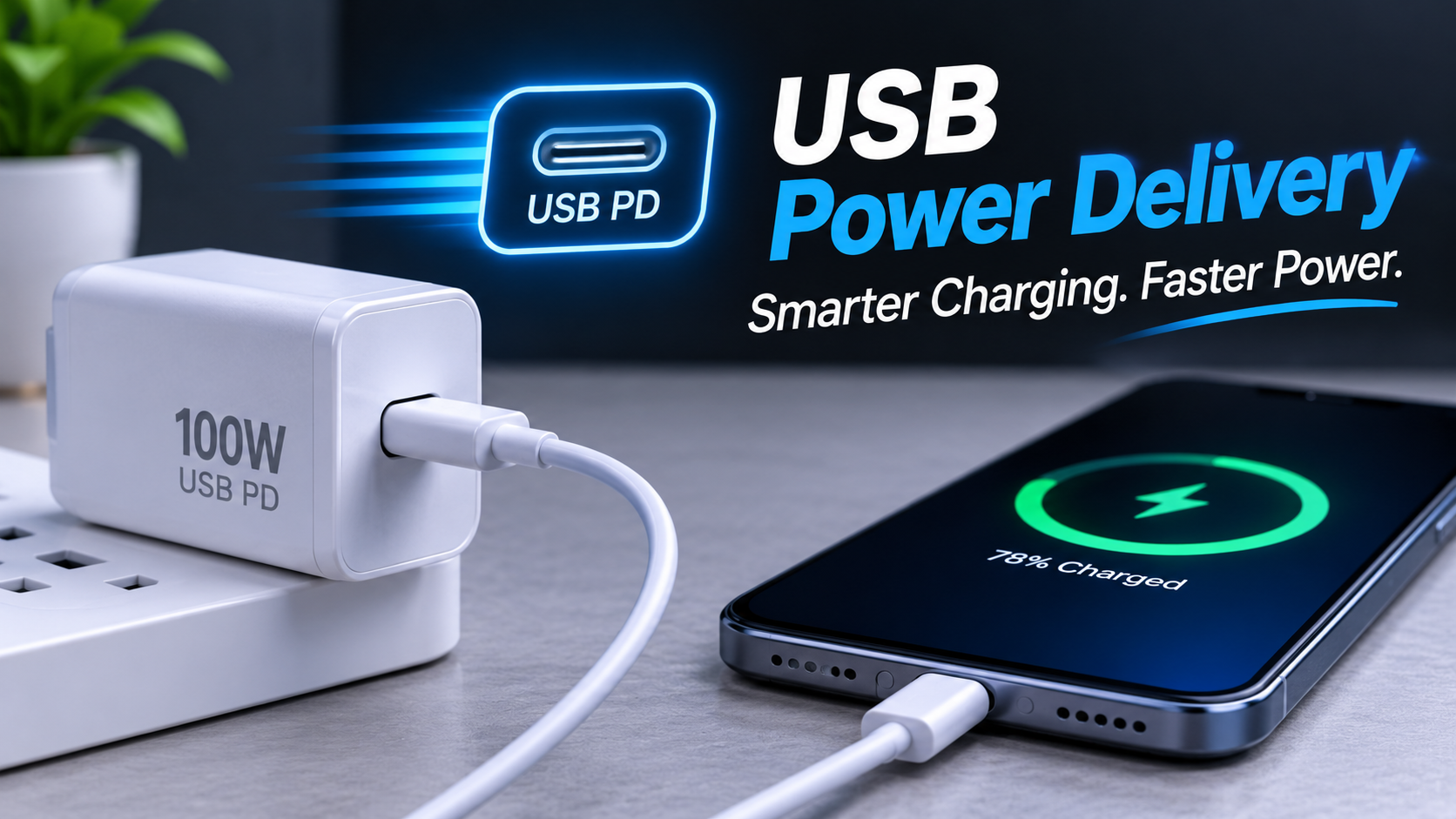
USB Power Delivery starts with a negotiation, not a single fixed output. The charger advertises what it can supply, the device picks one of the available voltages, and the charger switches over.
The common fixed voltages are 5, 9, 15 and 20 V, with up to 20 V at 5 A reaching 100 W. USB PD 3.1, published in 2021, adds 28, 36 and 48 V for chargers above 100 W, up to 240 W.
That baseline matters because PPS only makes sense once you understand what fixed PD already does well. In other words, PD is already the backbone; PPS is the extra tuning layer.
Why fixed PD is enough for Apple devices and most laptops
iPhones, iPads and MacBooks use fixed USB PD, with laptops mostly leaning on 20 V. Their charging systems already work fine with the steady-voltage approach.
The phone or laptop does the voltage conversion itself, which means more heat is created inside the device rather than in the charger. That’s not a problem by itself, but it explains why some phones look for a smarter charging profile.
What PPS adds, and why it matters for some phones
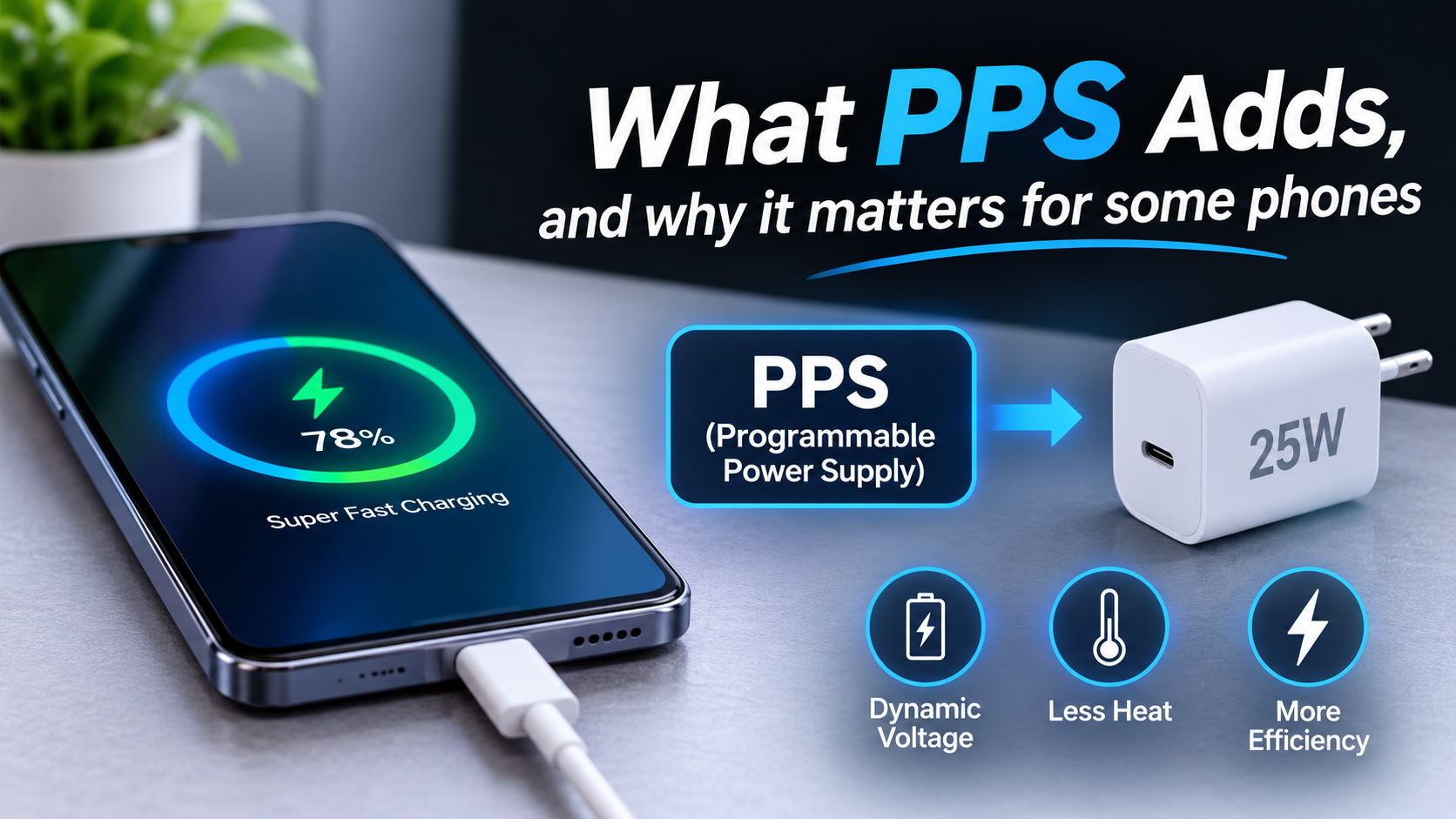
PPS, short for Programmable Power Supply, was added in USB PD 3.0 as an optional feature. Instead of choosing from only fixed voltages, the device can ask for an exact voltage within a range, in 20 mV steps, and set current limits in 50 mA steps.
That is why Samsung Super Fast Charging and Google Pixel PPS charging often depend on it: the phone can pull the voltage closer to what the battery wants at that moment, which reduces conversion loss and heat.
The key point is not more power. It is the same power delivered in a form the phone can use more efficiently.
How a PPS voltage range shows up on a charger spec sheet
A PPS range is usually written as something like 3.3 to 11 V, or 5 to 20 V. Phones using PPS generally work at the lower end of that range.
For charger buyers, the range matters because 5 to 11 V is enough for phone fast charging, while wider ranges add flexibility for other devices.
The 10-second PPS detail that keeps getting repeated wrong
One of the most common misunderstandings is the claim that PPS changes voltage every 10 seconds. That is not what happens.
The device has to send a new request at least every 10 seconds; if it does not, the charger treats the connection as lost and drops back to safe 5 V.
So the 10-second rule is a keep-alive check, not a schedule for voltage changes. It’s a small detail, but it changes how people interpret charger specs.
Which devices actually use PPS, and which do not
Not every device benefits from PPS. The split is fairly clean once you look at the devices people actually buy chargers for.
| Device | Fast charging uses | Does PPS matter? |
|---|---|---|
| iPhone, iPad | Fixed USB PD | No |
| MacBook and most laptops | Fixed USB PD, mostly 20 V | No |
| Samsung Galaxy (Super Fast Charging) | USB PD with PPS | Yes |
| Google Pixel | USB PD, with PPS on many models | Yes, for top speed |
| Older Android phones | Often Qualcomm Quick Charge | QC matters more |
Samsung makes the difference visible on screen: with a PPS charger, the phone shows “Super fast charging.” Without it, charging slows down. Some Samsung models also need a 5 A USB-C cable for 45 W mode, and many chargers support 25 W PPS but not 45 W.
Where Quick Charge and AVS fit beside PD and PPS
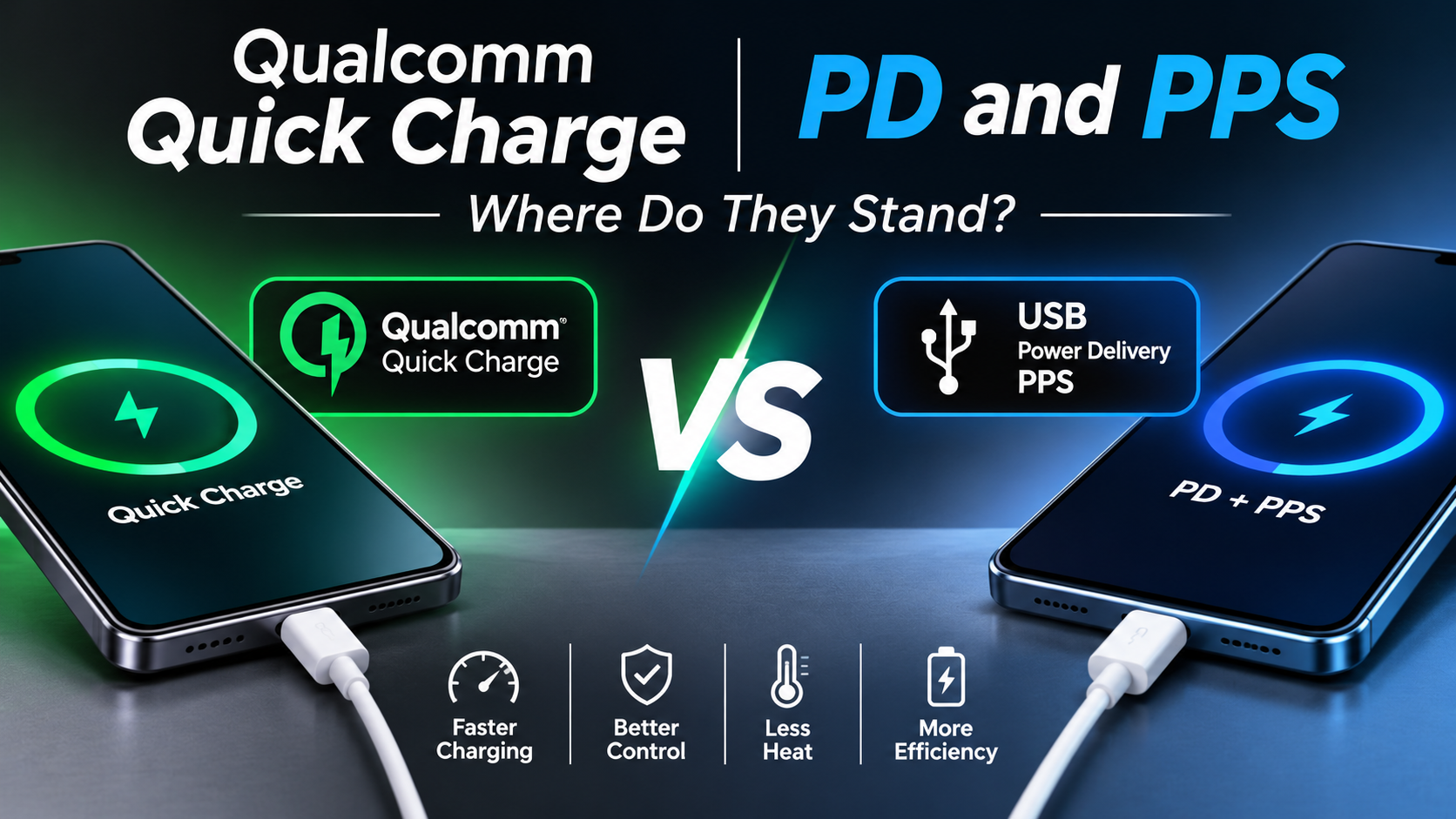
Qualcomm Quick Charge is still relevant, especially on a charger’s USB-A port, because many older Android phones continue to use it. Newer Quick Charge versions are built to work with USB PD, which is where the industry is heading.
AVS, or Adjustable Voltage Supply, is another adjustable-voltage mode in newer USB PD versions. It varies the voltage in larger steps, without PPS’s fine current limiting, and shows up on some spec sheets such as the XPD-V30.
How to read a USB-C charger spec sheet without missing the important bit
The cleanest spec sheet will separate fixed PD output from the PPS range. If it does not, you have to dig harder, because the difference is what tells you whether a charger will hit the right phone modes.
| Model group | Maximum PD output | PPS range |
|---|---|---|
| 30W, 35W and 45W | 20 V, up to 45 W | 5 to 11 V |
| 65W models | 20 V / 3.25 A | 5 to 20 V |
| MB 100W | 20 V / 5 A | 5 to 11 V |
| ZC504 140W | 28 V / 5 A (PD 3.1) | 5 to 20 V |
A 5 to 11 V range covers most phone fast charging, while wider ranges help with other device types. On multi-port chargers, there is one more thing to check: what happens when two devices are plugged in, because total power is shared and PPS can be reduced or dropped.
What actually matters when you’re buying or selling chargers
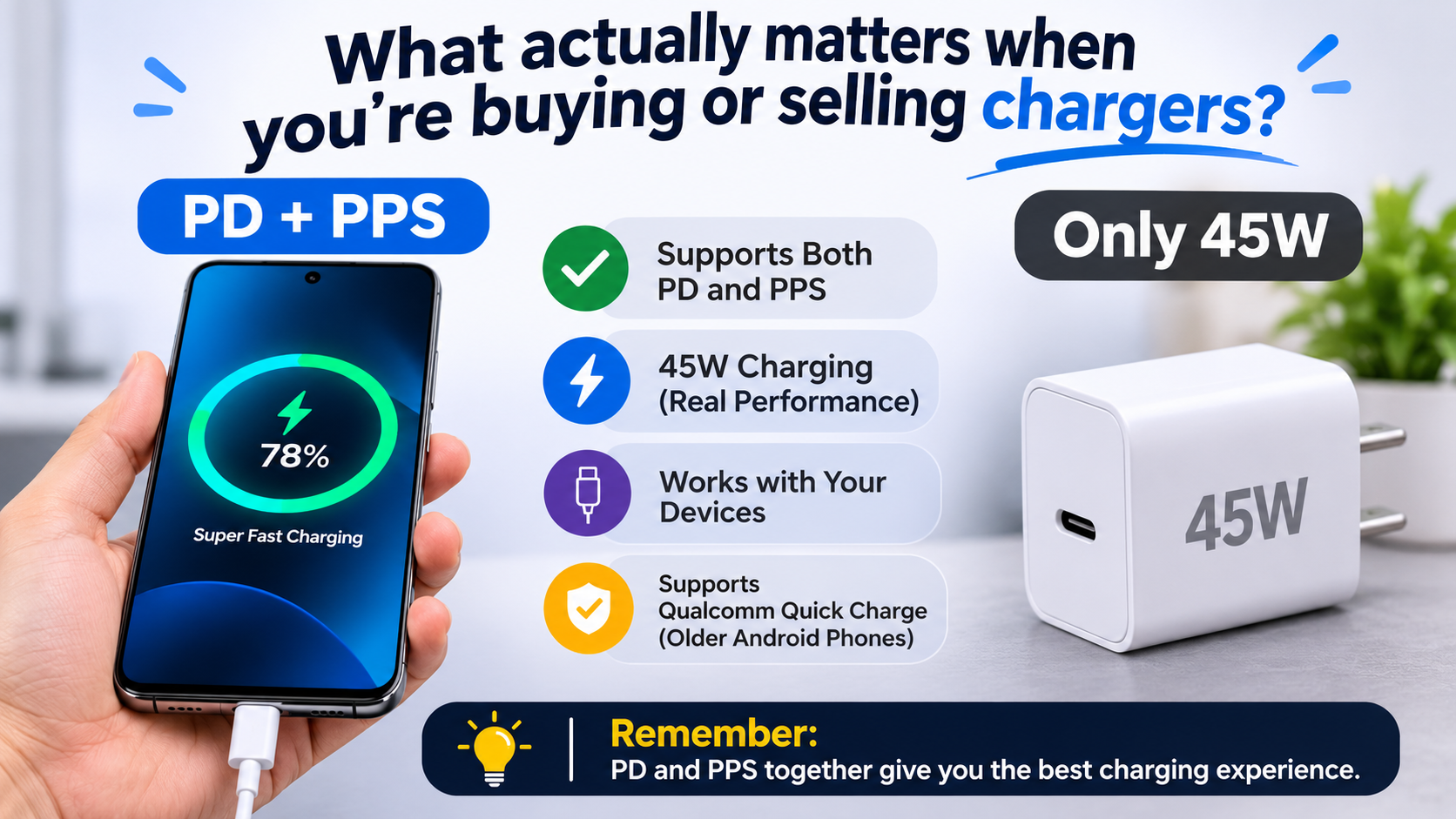
If the audience includes both iPhone and Samsung users, a charger with both PD and PPS is the safe choice. It covers Apple devices cleanly and still unlocks Samsung and Pixel fast-charging modes.
Listing PPS on the product page matters because Samsung owners search for it, and because “Will this super fast charge my phone?” is really the question behind the sale.
Two things decide whether the claim holds up in the real world: the cable, especially for 45 W charging, and actual testing with a USB-C power meter or PD analyser.
- Use both PD and PPS if the buyer base is mixed.
- Only claim Samsung 45 W charging if the PPS current and 5 A cable support it.
- Test sample units with the phones your customers actually use.
- Include the right cable, or say exactly which one is needed.
- Remember that all the listed chargers also support Qualcomm Quick Charge for older Android phones.
FAQ
These are the smaller doubts that usually show up after the main comparison is understood, especially around compatibility, safety, and whether PPS is really necessary.
Q: What is the difference between PD and PPS charging?
PD is the basic USB-C fast-charging standard with fixed voltages. PPS is an optional part of USB PD 3.0 that lets the device request finer voltage changes during charging.
Q: Does iPhone use PPS?
No. iPhones fast-charge on fixed USB PD, so a PPS charger works with them, but the PPS part is not used.
Q: Do Samsung phones need PPS?
For Samsung Super Fast Charging, yes. Without PPS, many Samsung phones fall back to slower charging, and some 45 W
modes also need a 5 A cable.
Q: Can I use a PPS charger with a non-PPS device?
Yes. A PPS charger is still a USB PD charger, so non-PPS devices use the fixed PD voltages or basic 5 V charging.
Conclusion
The simplest answer is that PPS is not a rival to USB PD at all: it is the part of USB PD that helps certain phones charge faster and cooler.
If you are buying or selling chargers, the practical move is to check for both fixed PD and PPS, then match the PPS range and cable to the devices you expect people to use.
The simplest way to understand USB PD vs PPS charging is that PPS is an added capability within USB PD, not a replacement for it. Standard PD is enough for fast charging on iPhones, iPads and MacBooks, while PPS can help compatible Samsung Galaxy and Google Pixel phones achieve their fastest charging modes.
For buyers, a charger supporting both USB PD and PPS is the most flexible choice, especially for households using different devices. Before buying, also check the charger’s PPS range, supported wattage and cable requirements, particularly if you want 45W charging on compatible Samsung phones.