QC 3.0 vs USB-PD vs VOOC: Which Fast Charging Protocol Actually Makes Sense

A 65W PD charger can become a compact bench supply with the right USB PD trigger boards, and that one detail is what makes this comparison worth reading for both phone buyers and makers.
If you’ve seen “QC 3.0 charging,” “65W PD,” or “33W VOOC” on a charger and had to stop and think, you’re not alone. Fast charging labels can feel like a little language problem. But once you understand what each one is actually doing, the whole thing gets a lot less confusing.
Quick Highlights
- USB-PD is the most flexible option overall.
- QC 3.0 still makes sense for many Snapdragon phones.
- VOOC is fast, but it stays inside its own ecosystem.
- For makers, PD trigger boards open up useful bench power.
- The best charger depends on the device, not the number on the box.
Introduction
The interesting part here is that a 65W PD charger can be turned into a compact bench supply. That’s where phone charging starts to overlap with actual electronics work, and it’s also why this comparison matters beyond just buying a wall adapter. The focus keyword, USB PD trigger boards, is the bridge between fast phone charging and practical desk power.
That’s also where the real tension sits. QC 3.0, USB-PD, and VOOC all promise speed, but they get there in very different ways. Those differences decide what you can safely buy, reuse, or build around. So if you’ve ever wondered why one charger works everywhere and another only works with one brand, this is the part that finally makes sense.
Why 5V charging feels slow the moment batteries got bigger
The old USB 2.0 ceiling of 5V at 500 mA — just 2.5 watts — made a 3000 mAh phone take 4–6 hours to charge. Back when batteries were smaller, that was annoying but manageable. Once phones grew into the 5000–6000 mAh range, it started to feel painfully outdated.
The basic power equation, P = V × I, is the whole story underneath the marketing. Higher current means more heat and thicker cables. Higher voltage shifts some of that work into the device itself. That’s why fast charging standards split so sharply in design philosophy. They’re all trying to solve the same problem, just in different ways.
What QC 3.0 changed, and why it still matters in India
Qualcomm Quick Charge is still the most familiar fast charging path for many Snapdragon phones, especially mid-range and flagship Android models from Xiaomi, Realme, OnePlus, some Samsung devices, and Motorola. The protocol works by negotiating voltage over the USB D+/D- pins instead of staying fixed at 5V. In plain English, the charger and phone talk to each other and agree on what level makes sense.
QC versions and their practical limits:
- QC 1.0: 5V/2A = 10W, with simple current increase and backward compatibility
- QC 2.0: up to 12V/1.67A = 18W, with 5V, 9V, and 12V modes
- QC 3.0: up to 18W, with INOV and voltage steps from 3.6V to 20V in 200mV increments
- QC 4.0/4+: up to 100W, USB-PD compatible, with dual-charge paths that bypass the PMIC
- QC 5: 100W+, multiport support, and a claimed 4500 mAh phone charge from 0–50% in 5 minutes
The version that actually shows up most often in India is QC 3.0. It gives you practical 18W output, less heat than QC 2.0, and the usual 0–50% charge on a 4000 mAh phone in about 30 minutes when the charger and device both cooperate. That’s not miraculous, but it’s solid, and for a lot of people it’s still good enough.
What QC 3.0 really needs to work
It is not just “a Qualcomm charger.” You need a Qualcomm-certified charger and a Snapdragon device with QC support. A QC 3.0 charger will still work backward with QC 2.0 devices, just more slowly. That detail matters because people often assume any fast charger will magically speed up any phone, and that’s simply not how it works.
QC is common in bundled Redmi, Realme, and other mid-range Snapdragon phone chargers sold in India, which makes it a practical default even if it is no longer the most flexible option. If you already own one, it can still be very useful. It’s just not the universal answer anymore.
Why USB-PD is the one standard that keeps showing up everywhere
USB Power Delivery is the open standard from USB-IF, and that openness is exactly why it crosses brands so cleanly. It uses the CC pins on USB-C and negotiates Power Data Objects, so the charger and device agree on a voltage and current profile instead of forcing one fixed mode. If that sounds technical, think of it like a smart negotiation instead of a blunt yes-or-no switch.
USB-PD power ranges and device support:
| Version | Maximum power | Common profiles |
|---|---|---|
| PD 2.0 / 3.0 | 100W | 5V, 9V, 15V, 20V |
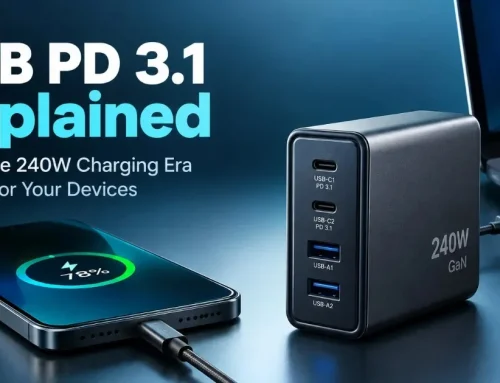
| PD 3.1 | 240W | 48V / 5A EPR |
Apple MacBooks, iPads, iPhones 8 and later, Google Pixel phones, Samsung Galaxy S21+, and Nintendo Switch are all part of that ecosystem. The nice part is that USB-PD works over USB 2.0 through USB4 cable speeds because power delivery is separate from data speed. So, the charger doesn’t need to “know” your file transfer speed to deliver the right power.
Why makers care more about USB-PD than phone buyers do
A 65W USB-PD charger can cover a laptop, iPad, smartphone, and wireless earphones in one go. That’s why it starts to look less like a phone accessory and more like a general-purpose power tool. For a lot of people building a clean travel kit, that’s the real appeal.
For projects, the real advantage is the trigger board: a small PCB that can request 9V, 12V, 15V, or 20V and hand that voltage out to a workbench load, whether that is a 12V LED strip, a fan, or another test setup. This is where USB-PD becomes more than convenience. It becomes useful.
Where USB-PD shows up in actual hardware
- Raspberry Pi 4 and Raspberry Pi 5 require USB-C PD power
- The official Raspberry Pi 5 adapter is 27W
- Many modern 3D printer controllers accept 24V PD input
- ISDT smart chargers can be powered from a 65W USB-PD charger set to 20V output
- TP4056 charging modules for 18650 cells work fine with standard 5V from QC chargers, but QC fast charging itself is irrelevant for single-cell charging at 1A max
That last point surprises people sometimes. A lot of charging modules do not care about “fast charging” in the phone sense at all. They just need stable power. And that’s exactly where USB-PD starts to feel like the cleaner long-term choice.
Why VOOC, Dash, and Warp feel faster but lock you into the brand
OPPO’s VOOC family takes the opposite route from QC and PD. It keeps voltage low and pushes current very high, so more heat stays in the charger instead of the phone. That is why VOOC-style charging often feels cool even when it is moving real power. It’s a neat trick, honestly, but it comes with a catch.
VOOC family and related proprietary systems:
- VOOC original: 5V/4A = 20W, used in OPPO and Realme phones
- VOOC 4.0 / Flash Charge: 5V/6A = 30W
- SuperVOOC: 10V/6.5A = 65W, with dual-battery architecture
- Dash Charge: OnePlus’s 5V/4A = 20W, licensed from OPPO
- Warp Charge 30 / 65: OnePlus’s 30W and 65W variants
- Huawei SuperCharge: 10V/4A = 40W, proprietary and not compatible with QC or PD
The catch is simple: these protocols only work inside their own ecosystem. A VOOC charger will not fast-charge a Xiaomi phone, and a QC charger will not VOOC-charge an OPPO phone. If you use the wrong charger or cable, you usually drop back to standard 5V/2A charging. So yes, the fast speed is real, but so is the lock-in.
Why VOOC cables are part of the protocol, not an accessory
VOOC needs proprietary cables with extra data pins to negotiate the charge and carry the current. If someone swaps in a generic cable, the charger often falls back to normal speeds. That’s why so many Indian users think the charger “stopped fast charging” when the cable was the real problem. It’s not a small detail. It’s part of the system.
Which charger makes sense for your phone, your travel bag, or your bench
The right choice depends on what you are actually trying to power. For a Snapdragon phone, QC 3.0 still makes sense. For iPhone, Pixel, or a mixed-device setup, USB-PD is the obvious default. For OPPO, Realme, and OnePlus, the bundled charger usually remains the fastest option. There isn’t one winner for everything, and that’s okay.
Practical buying logic:
- Daily phone charging in India: match the charger to the phone’s SoC and ecosystem
- Universal travel charger: look for a 65W GaN USB-C charger that supports both USB-PD and QC 3.0
- Makers and electronics projects: choose USB-PD plus USB PD trigger boards
- Drone and RC batteries: use USB-PD to power the smart charger, not to charge the LiPo pack directly
For India, one more detail matters: a good travel charger should be BIS-approved for 230V/50Hz power. A compact 65W GaN USB-C charger is usually the most sensible all-rounder if you want one device to cover most cases. It’s the kind of purchase that quietly makes life easier every single day.
FAQ
The questions people ask after the comparison are usually about safety, compatibility, and the kind of fast charging that still sounds suspicious the first time you hear it.
Q: Will a QC 3.0 charger damage a non-QC phone?
No. If the phone does not support QC, it falls back to standard 5V charging after handshake, so the higher voltages are never applied.
Q: Can I use a USB-PD charger with a phone that still has Micro-USB?
Not directly. USB-PD needs USB-C, though some chargers also include USB-A ports that can still provide standard 5V/2A output.
Q: Does fast charging damage batteries?
Properly implemented fast charging does not significantly damage batteries beyond normal wear, but high ambient heat, repeated 100% charging, and uncertified chargers do make degradation worse.
Q: What is GaN charging, and does it change the protocol?
GaN only makes the charger smaller and more efficient. A 65W GaN charger can support USB-PD, QC 3.0, or both, but GaN itself is not the charging protocol.
Conclusion
For most people, the answer is straightforward: QC 3.0 remains useful for Snapdragon phones, USB-PD is the most flexible standard, and VOOC is fast but ecosystem-bound.
If you are buying for everyday use, travel, or maker work, the safest long-term choice is usually USB-PD — especially a 65W setup with trigger boards if you want the charger to do more than charge a phone. That’s the part worth remembering.