
Open-Ear Earbuds vs In-Ear Earbuds Which One Fits Your Day Best?

Choosing between open-ear earbuds vs in-ear earbuds sounds simple at first. Then real life gets involved. You’ve got a commute, a workout, a call, maybe a noisy café, maybe a quiet office, and suddenly the “best” pair depends on what kind of day you’re actually living.
That’s the real story here. Comfort, ANC, bass, and awareness are the four things that usually decide the whole purchase. The real question is whether you want your earbuds to shut the world out or leave it half-open.
Quick Highlights
Introduction
Compare comfort, ANC, bass, and awareness to see whether open-ear earbuds vs in-ear earbuds fit your routine best.
The choice only looks simple until you notice how much your day changes from commuting to calls to workouts, and one style handles those situations very differently. If you’ve ever bought earbuds for one reason and then found yourself annoyed in the middle of a normal Tuesday, you already know how fast this gets real.
In a quiet room, almost anything sounds decent. But once you step onto a train, start walking outside, or try to focus in an open office, earbuds stop being just earbuds. They become a tool for control, comfort, and sometimes sanity. That’s why the open-ear earbuds vs in-ear earbuds debate keeps coming up. It’s not really about trends. It’s about how much of the world you want to hear while you listen.
What changes the second the earbuds go in your ears
In-ear earbuds sit inside the ear canal, and that seal is doing a lot of the work: stronger bass, richer sound, and better noise reduction all come from it.
Open-ear earbuds rest outside the ear canal instead, which keeps the ear open to traffic, public announcements, conversations, and other background sound.
That split is really about two different listening priorities: immersion on one side, awareness on the other. And once you understand that, a lot of the decision gets easier. You stop asking, “Which is better?” and start asking, “What kind of listening do I need most often?”
That’s a much more useful question, because the answer changes with your routine. A person who works from home and takes a few calls during the day may want something very different from someone who runs at sunrise or commutes through a busy station. The earbuds don’t change. The day does.
Why in-ear earbuds are still the default for focused listening
They are the most common match for Active Noise Cancellation, because the physical seal gives ANC something to build on.
That is why they keep showing up as a better fit for travel, work, podcasts, and anything where you want the sound to stay inside your head.
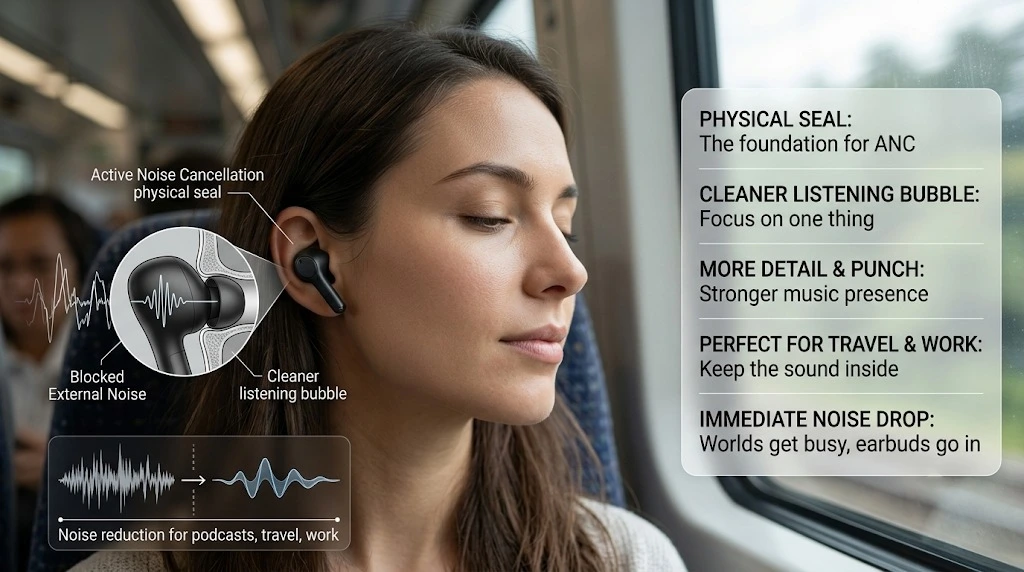
There’s also a simple practical reason they remain the default: they create a cleaner listening bubble. When the ear canal is sealed, the audio doesn’t have to fight outside noise as hard. The result is usually more detail, more punch, and a stronger sense that the music or podcast is right there with you. If you like focusing on one thing and letting the rest fade away, this style makes a lot of sense.
For a lot of people, that’s the whole appeal. The world gets busy, earbuds go in, and the noise drops. It’s not glamorous, but it works. And when it works, you notice it immediately.
Why open-ear earbuds feel easier for long wear
Nothing is pushed into the ear canal, so a lot of people find them better for ear fatigue, all-day calls, and long listening sessions.
The comfort gain matters most when earbuds stop being a short task and start becoming part of the whole day.
That’s the part people don’t always think about until it’s too late. A pair can sound great for twenty minutes and still become annoying after two hours. Open-ear designs often feel lighter in that sense, almost like they’re sitting nearby instead of sitting on top of the most sensitive part of your ear. If you wear earbuds during long meetings or casual listening while moving around the house, that little bit of freedom can matter a lot.
There’s also the mental side of it. Some people simply don’t like the closed-off feeling that in-ear tips can create. Open-ear earbuds can feel more relaxed, less “inserted,” and easier to forget about. And honestly, forgetting about your earbuds is usually a good sign.
Sound, bass, and the trade-off people usually notice first
In-ear earbuds usually win on sound quality because the sealed fit keeps audio contained and gives bass more weight.
Open-ear earbuds are making up ground for casual listening, podcasts, calls, and workouts, but they are still built for a more natural sound rather than a heavy bass experience.
The gap matters less if you mostly listen while moving, and more if you care about music feeling fully boxed in. That “boxed in” feeling is a big part of why people still choose in-ear models. They can make a playlist feel bigger, fuller, and more complete, especially when the outside world is loud and messy.

But the trade-off is worth saying plainly: open-ear earbuds usually don’t hit with the same low-end weight. That doesn’t mean they sound bad. It means they’re solving a different problem. They’re often better for spoken audio, background music, and situations where being aware matters more than feeling every bass line in your chest.
So if you mostly use earbuds for podcasts, voice notes, light playlists, or casual listening while doing something else, open-ear may feel perfectly enough. If music is something you sit with and pay attention to, in-ear is usually the safer bet.
How bone conduction headphones fit into the open-ear category
Some open-ear earbuds use bone conduction technology, but not all of them do.
Bone conduction headphones send vibrations through the bones near the ears, while speaker-based open-ear earbuds keep the ear canal open in a different way; both let you stay aware of your surroundings.
That’s an important distinction because people sometimes use the terms as if they’re all the same thing. They’re not. Bone conduction headphones are one approach to open listening, while speaker-style open-ear designs are another. Both preserve environmental awareness, but they do it differently and can feel different on your face and ears.
In practice, the choice often comes down to how you want the sound to reach you and how
much external awareness you need while moving.
- Open-ear earbuds and bone conduction headphones both preserve environmental awareness.
- Open-ear earbuds are generally designed to deliver richer sound and more bass than standard bone conduction
headphones. - Both can work well for running, walking, cycling, and other outdoor activities where awareness matters.
If you’ve only tried one of these categories before, it’s easy to assume they all behave the same way. They don’t. Some feel more natural, some feel more secure, and some are simply better if you’re trying to hear traffic, warning
signals, or the person calling your name from across the path.
ANC, noise cancellation, and when blocking sound actually helps
ANC works best when the earbuds already form a seal, which is why in-ear earbuds get the biggest
benefit from it.
That seal-plus-software combination is useful on traffic, airplanes, public transport, busy offices, and cafés.
Open-ear earbuds are meant to do the opposite: they let sound in, so traditional noise cancellation matters less by design.
This is where the categories really separate. If your daily problem is too much noise, then blocking sound becomes a feature, not a bonus. In-ear earbuds with ANC can take the edge off engines, chatter, and that constant low-level hum that makes it hard to think. It doesn’t make the world disappear completely, but it can make it feel manageable.
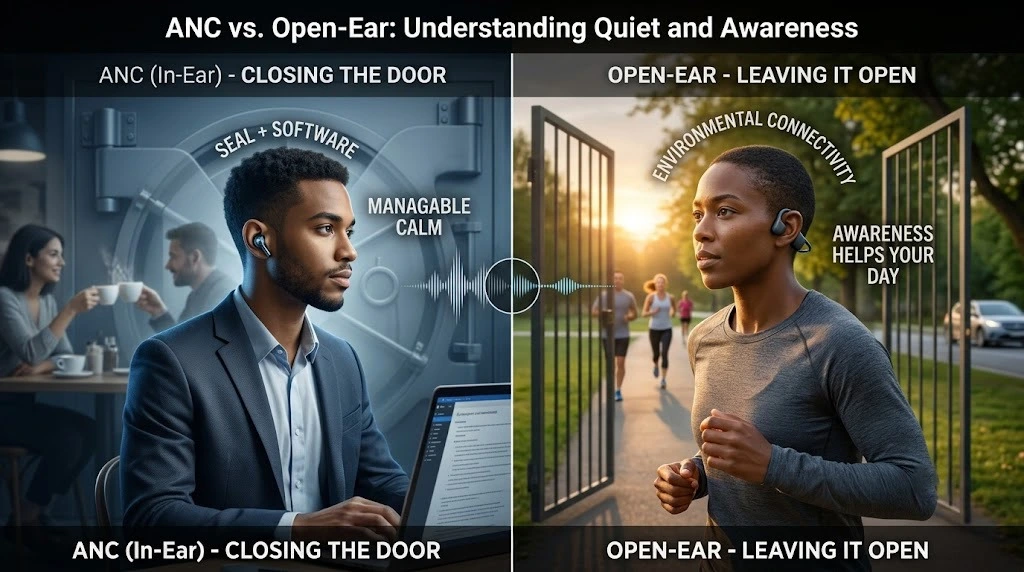
Open-ear earbuds are not trying to win that game. They’re trying to keep you connected to what’s around you. That can be a huge advantage outdoors or when you need to stay available to people around you. It’s one of those cases where “less isolation” is actually the whole point.
Here’s a simple way to think about it: ANC is like closing the door. Open-ear is like leaving it open on purpose. Neither choice is wrong. It depends on whether quiet or awareness helps your day more.
If you spend a lot of time in places where sound control matters, in-ear earbuds usually give you more of what you want. If your environment changes constantly and you need to notice what’s happening around you, open-ear makes more sense. That difference sounds obvious on paper, but in daily life it shows up in little moments: hearing an announcement, noticing a cyclist, catching a coworker speaking to you, or realizing you’ve been wearing your earbuds so long that comfort suddenly matters more than sound.
Which style fits the way you actually move through the day
The better choice changes depending on whether your day is mostly controlled or constantly interrupted.
Commuting, traveling, studying, and working in busy environments all point toward in-ear earbuds; running, walking, cycling, and being outdoors point toward open-ear earbuds.
That same split also explains why some people buy one pair for focus and another for movement. It’s not overkill if you really use both modes of living. Some days call for silence and concentration. Other days call for hearing the world while you keep moving through it.
The important thing is not to pick the “best” earbuds in a vacuum. Pick the style that matches the moments you repeat most often. That’s where value lives. A pair that fits your routine will always feel smarter than a pair that only looks better on a spec sheet.
The four use cases that tilt the decision fastest
- Travel and commuting: in-ear earbuds usually fit better because of stronger bass, sound
isolation, and ANC. - Running and outdoor workouts: open-ear earbuds are often the better call because they keep
traffic, warning signals, and other people audible. - Office and study use: in-ear earbuds are stronger when distraction control matters most.
- All-day comfort: open-ear earbuds often feel easier when you wear them for hours.

That’s the short version, but it’s also the useful version. If you’re on trains, in meetings, or trying to shut out a noisy environment, in-ear earbuds probably win. If you’re moving through streets, trails, or a busy home and still want to hear what’s around you, open-ear earbuds make a lot more sense. The way you move through the day usually tells you the answer before the marketing does.
Baseus picks that match the two listening styles
The article’s product choices line up with the same divide: one pair for focus, one for everyday awareness, one for outdoor movement.
The names, price reference, and feature mix matter here because they show how the category splits in real products, not just in theory.
The Baseus Inspire XP1 is the kind of in-ear option that leans into the focus side of the story. With a contoured ergonomic design, Sound by Bose, Dolby Audio, Premium Adaptive ANC, long battery life, and all-day comfort, it’s clearly built for people who want more immersion and less distraction.
The Baseus Bowie MC2 is more of an everyday open-ear choice. It’s made for music, podcasts, and calls while still hearing the environment, which makes it practical for walking, commuting, working from home, and casual tasks. The noted price of $59.99 USD / $79.99 USD gives it a more accessible feel, especially if you’re trying open-ear earbuds for the first time and don’t want to overcommit.
Then there’s the Baseus Inspire XC1, which is another open-ear option aimed at people who care about traffic awareness, cyclists, running, walking, and outdoor workouts. That makes sense because it’s not trying to be the most isolating pair. It’s trying to be the most usable when movement and safety matter.
What’s useful about seeing real models like this is that the category stops feeling abstract. You can imagine where each one fits. One is for focus. One is for everyday awareness. One is for movement and safety. That’s the same choice you’re making, whether you name it that way or not.
FAQ
The questions here come from the smaller doubts people still have after they understand the main trade-off.
Q: Which is more comfortable, open-ear earbuds or in-ear earbuds?
Comfort is personal, but open-ear earbuds often feel better over longer periods because nothing sits inside the ear
canal.
Q: Are in-ear earbuds bad for your ears?
Not necessarily. They are safe when used responsibly and at reasonable volume levels.
Q: Do open-ear earbuds leak sound?
Yes, some sound can be heard by people nearby at higher volumes. How much depends on the design and how loud you play
them.
Q: Should I choose open-ear earbuds if I run outside?
Usually, yes, if awareness matters to you. Open-ear earbuds are often a better fit for running because they keep you
more aware of traffic, people, and other surroundings.
Q: Can in-ear earbuds work for workouts too?
Absolutely. If you want a more locked-in sound and don’t mind the sealed fit, in-ear earbuds can be great for
training, gym sessions, and any workout where you want stronger bass and less outside noise.
Q: Is there a big sound quality gap between the two?
There can be, especially for bass and isolation. In-ear earbuds usually sound fuller, while open-ear earbuds are improving fast and are often more than good enough for casual listening, calls, and movement.
Conclusion
If your goal is stronger bass, better isolation, and a more focused listening experience, in-ear earbuds make the most sense. If you want comfort, awareness, and a pair that disappears into everyday movement, open-ear earbuds are usually the better fit.
The practical answer is not about which type is better overall; it is about which one matches the kind of attention your day demands. That’s the heart of the open-ear earbuds vs in-ear earbuds decision. One style helps you tune the world out. The other helps you stay connected to it.
So, before you chase the longest battery life or the flashiest feature list, think about your routine in plain terms. Where do you listen most? What do you need to hear? And how long do you actually wear them? Once you answer those questions, the right pair usually becomes pretty obvious.