Can You Charge a Phone With a Laptop Charger? What Actually Matters

Introduction
Can you safely charge phone with laptop charger? A lot of the time, yes — but only if the charger, cable, and phone are speaking the same language. That’s where people get tripped up, because USB-C makes everything look interchangeable when it really isn’t.
The big idea is simple: the same plug doesn’t always mean the same charging behavior. What really matters is USB-C PD charging compatibility, along with the cable and the device’s own limits.
Quick Highlights
- USB-C shape alone doesn’t guarantee fast charging.
- The charger, cable, and phone all have to match up.
- Higher wattage doesn’t force extra power into the phone.
- A bad cable can slow things down more than you’d expect.
When a laptop charger will charge your phone safely
The short answer is yes: a laptop charger can charge a phone safely when the charger, cable, and phone all support the same standard. That sounds obvious, but it’s the part people usually skip.
USB Power Delivery is built to negotiate power between devices, which is why a USB-C laptop charger often works fine with a phone instead of blasting it with maximum output. The phone asks for what it needs, and the charger responds within that range.
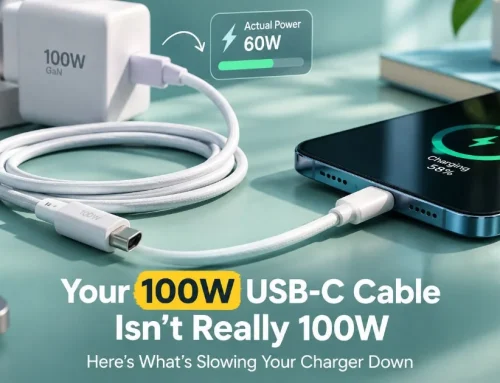
That’s also why the charger’s label can be less important than you’d think. A charger might say 65W or even 100W, but your phone won’t just gulp down all of that power. It only draws what it’s designed to accept.
So, if the charger is a good-quality unit, the cable is rated properly, and the phone supports the same protocol, the setup is usually safe. In everyday terms, it’s more like a smart conversation than a power shove.
How to check USB-C PD, wattage, and the cable before you plug in
The safest check starts with the charging standard, then moves to output wattage, then the cable, then the phone maker’s own guidance. That order matters more than most people realize.
Apple says fast charging for many recent iPhones needs a compatible 20W or higher USB-C power adapter, and Apple’s USB-C iPhone guidance also points to a compliant USB-C cable for faster charging. That doesn’t mean every charger has to be from the phone brand, but it does mean the setup needs to meet the spec.
Here’s the thing: a strong charger with the wrong cable, or the wrong protocol, can still underperform. You might see charging happen, just not as fast as expected. Sometimes people blame the charger when the cable is really the weak link.
USB-C on the charger and phone does not automatically mean the same charging mode
USB-C is just the connector shape. A charger and phone can both use USB-C and still not support the same fast-charging system.
USB Power Delivery is the common one to look for, and USB-IF says it is designed to negotiate power safely between the charger and device. That negotiation is what keeps the setup from feeling like a gamble.
So if you’re checking a charger, don’t stop at the port. Look for the charging protocol too. Same plug, different rules.
Why the phone charging wattage range matters more than the biggest number on the box
Compare the charger’s rated output with your phone’s recommended charging wattage instead of chasing the highest wattage number available. Bigger isn’t automatically better here.
A 65W charger does not make a 20W phone charge at 65W, because the phone only takes what it is built to accept. That’s one of the nicest things about modern charging standards, honestly — they’re designed to avoid that mismatch.
Think of it like a faucet and a glass. The faucet might be capable of pouring out a lot more, but the glass still decides how much it can hold without spilling over.
Why the cable can slow everything down even when the charger is strong
A weak, damaged, or low-spec cable can reduce charging reliability or cap charging speed. And yes, that can happen even when the charger itself is perfectly capable.
For USB-C iPhones, Apple specifically recommends a compliant USB-C cable for faster charging, so swapping the cable is often the first smart test. If the phone charges better with a different cable, you’ve probably found the bottleneck.
This is why people sometimes buy a powerful laptop charger and still feel disappointed. The cable is the middleman, and if it’s not up to the job, the whole setup feels slower than it should.
Will a laptop charger make your phone charge faster?
Sometimes it will, but only when the phone can use the extra power and the standard supports it. That’s the part that matters most.
Apple UK says iPhone 15, iPhone 16, and iPhone 17 series phones can fast charge with a compatible USB-C Power Delivery adapter, so a 65W USB-C laptop charger can work quickly when the cable matches too. In other words, the charger doesn’t magically make the phone faster by itself; it just gives the phone access to more headroom if the phone is built for it.
If the phone only accepts 20W or another lower speed, the extra wattage does not override the phone’s limit; USB PD works by negotiation, not by forcing power in. That’s why a laptop charger can be helpful without being risky. It’s not pushing the phone beyond its design.
If you’ve ever plugged in a “really powerful” charger and expected dramatic results, this is where the reality check comes in. The charging speed is usually capped by the phone, not the charger.
FAQ
These are the smaller doubts people usually have after they’ve already decided the charger might work.
Q: Is it okay to use a 65W charger for an iPhone?
Yes, a 65W USB-C power adapter is generally fine for iPhone 15 and later with USB-C connectors, as long as it meets safety standards. The phone only negotiates the power it can use, so the larger wattage doesn’t automatically mean more risk.
Q: Is a laptop charger too powerful for my phone?
Usually no, if the charger and phone support a compatible standard such as USB-C Power Delivery. USB-IF says the device takes only the power it requires, so the phone isn’t being forced to accept the full output.
Q: Can I charge a 33W phone with a 65W charger?
Yes, in most cases. If the charger and phone support matching USB-C PD or another compatible fast-charging standard, the phone will draw only up to its own limit. The number on the charger is more like capacity than pressure.
Q. How fast will a laptop charge your phone?
Conclusion
Charge phone with laptop charger is not really a wattage question; it is a compatibility question.
If the port type, charging protocol, cable, and phone’s supported charging spec all line up, the setup is usually safe and may charge faster than an older low-power plug. And that’s the real takeaway: don’t just look at the size of the charger. Look at the whole chain.
So, before you plug in, check the spec once, then you can charge with a lot more confidence.