DDR4 vs DDR5 RAM in India What Actually Makes Sense for Your PC in 2026?

DDR4 vs DDR5 RAM in India comes down to value: a 16GB DDR4 kit costs around ₹3,500-5,000, while a similar DDR5 kit starts at ₹6,000-8,000. DDR4 is the better buy for most budget builds under ₹70,000, because the savings can go into a stronger GPU. DDR5 makes more sense for high-end gaming PCs, video editing and long-term builds, and it is the only option on AMD AM5. For most gamers, 32GB DDR4 is a safer pick than 16GB DDR5, since several modern games use 15-18GB of RAM. Check your motherboard first, because DDR4 and DDR5 are not compatible.
The real choice in 2026 is not “faster or slower” — it is whether paying ₹3,500-5,000 for DDR4 or ₹6,000-8,000 for DDR5 gives you better value for the kind of PC you’re actually building.
Quick Highlights
- DDR4 still offers better value for most budget builds.
- DDR5 helps more in high-end and bandwidth-heavy workloads.
- 32GB often makes more sense than chasing speed alone.
- Your motherboard choice matters as much as the RAM itself.
Introduction
In India, a 16GB DDR4 kit still lands around ₹3,500-5,000, while a similar DDR5 kit starts at ₹6,000-8,000. That price gap is the reason the DDR4 vs DDR5 RAM in India question keeps coming back.
The article is really about where speed matters, where capacity matters more, and when “future-ready” is just a more expensive way to buy the same experience today. And honestly, that’s the part most people get stuck on. Nobody wants to overspend on something tiny like memory, but nobody wants to cheap out and regret it either.
What actually separates DDR4 from DDR5
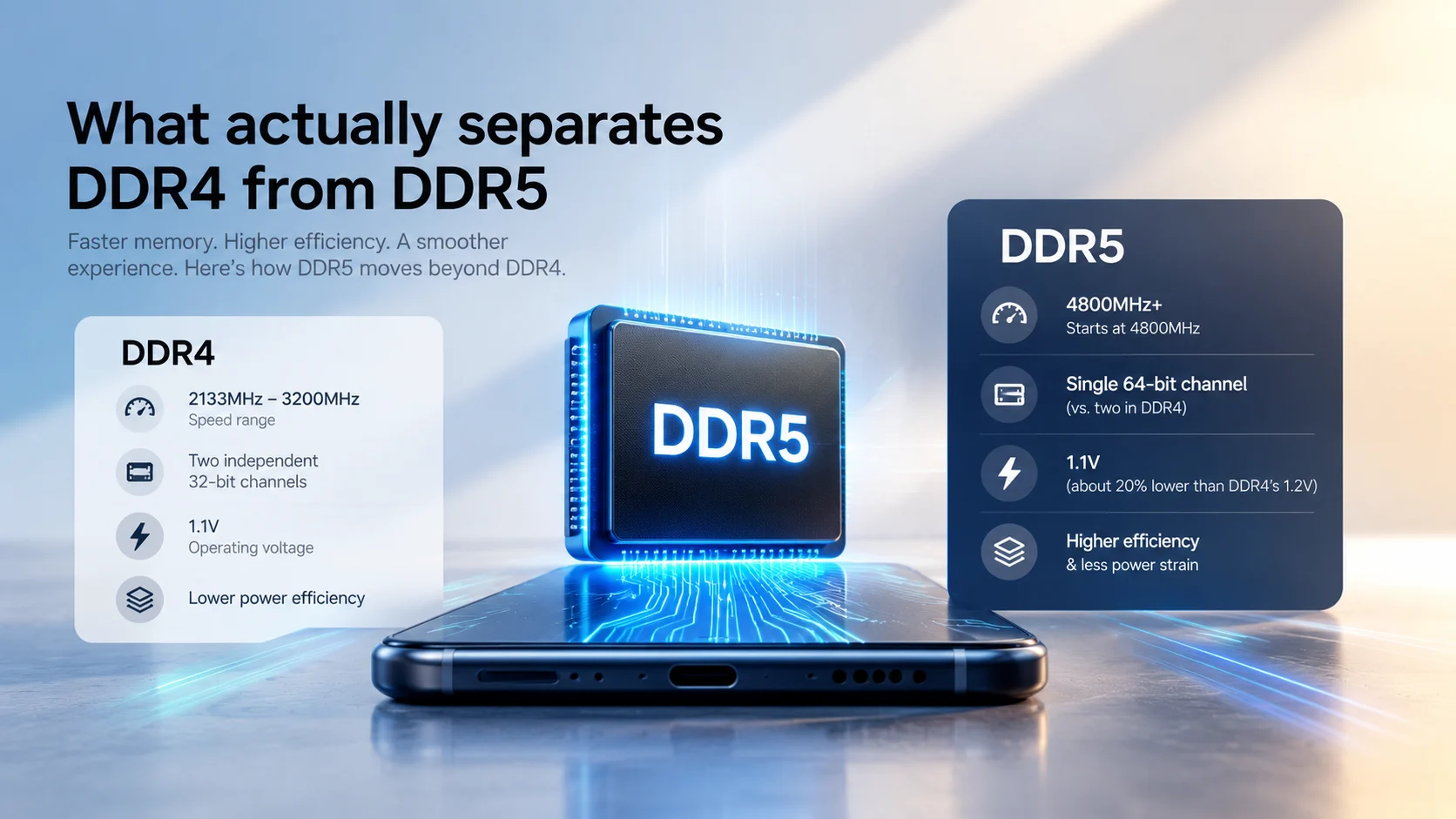
The gap starts with speed, but it doesn’t end there. DDR4 usually runs from 2133MHz to 3200MHz, while DDR5 starts at 4800MHz and can go beyond 6400MHz in consumer kits.
That faster memory also changes architecture: DDR5 uses two independent 32-bit channels, while DDR4 runs on a single 64-bit channel, and DDR5’s 1.1V operating voltage is about 20% lower than DDR4’s 1.2V. That lower voltage doesn’t magically transform your PC, but it does show how the newer standard is designed to push more data with less power strain.
Speed, bandwidth, and the work that benefits most
DDR5 can move data almost twice as fast in the right conditions, which matters more in bandwidth-heavy work like 4K video editing and complex simulations than in everyday browsing or lighter gaming.
So if your day mostly looks like Chrome tabs, Office work, and a bit of gaming, the difference can feel surprisingly small. But if you’re moving huge files, scrubbing timelines, or running heavy workloads in the background, the extra bandwidth starts to make sense in a very practical way.
The physical differences that stop you from mixing them
The notch position on the connector is different, so DDR4 will not fit into a DDR5 slot and DDR5 will not fit into a DDR4 slot. No motherboard supports both types at the same time.
This sounds basic, but people still trip over it when they’re browsing listings fast. If you’re upgrading, you have to check the board first. If you’re building new, the motherboard decides everything.
When DDR5 actually shows a gaming advantage
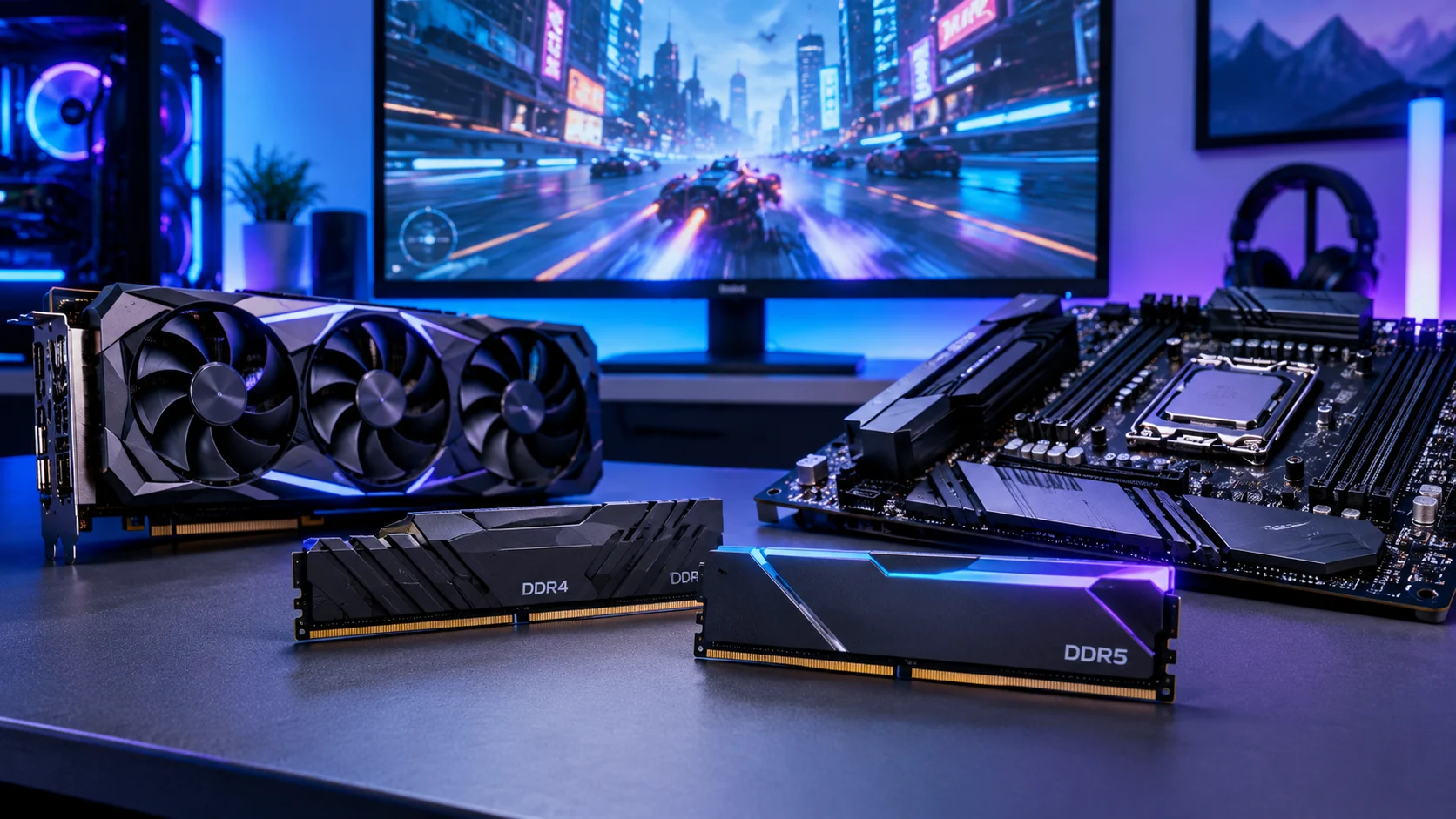
DDR5 does improve gaming, but not everywhere in the same way. In titles like Cyberpunk 2077, Hogwarts Legacy, and The Last of Us Part II, the uplift is around 10-15%, while many 1440p and 4K results shrink to roughly 5%.
That difference becomes easier to see in CPU-bound situations, especially at 1080p with a powerful card like the RTX 5090, where the CPU and RAM become the limiter instead of the GPU. So if your monitor and graphics card are already doing most of the work, RAM speed can become a smaller part of the story.
Why esports titles can show bigger gains
Fast competitive games such as Counter Strike 2, Valorant, Rainbow Six Siege X, and Marvel Rivals can show results that are up to 20% better with DDR5.
That is mostly about frame consistency and 1% lows, not just peak FPS. And that’s a big deal if you care about the game feeling smooth under pressure, not just looking good in a benchmark screenshot.
| Game / scenario | DDR4 result | DDR5 result |
|---|---|---|
| Cyberpunk 2077, Hogwarts Legacy, The Last of Us Part II | Baseline | 10-15% higher frame rates |
| 1440p and 4K gaming in many titles | Close to DDR5 | Often only about 5% ahead |
| 1080p with a high-end GPU like RTX 5090 | More bottlenecked by CPU/RAM | More visible advantage |
| Esports titles like CS2, Valorant, Rainbow Six Siege X, Marvel Rivals | Good, but less consistent at the top end | Can be up to 20% better |
What Indian buyers should do with a limited budget

Price is still the part that changes the decision most. A 16GB DDR4 kit sits around ₹3,500-4,500 from brands like Corsair, G.Skill, and Adata, while comparable DDR5 kits run ₹5,500-7,000.
For 32GB kits, DDR4 lands around ₹6,500-8,500 and DDR5 around ₹10,000-13,000, while a B760 DDR4 motherboard is roughly ₹9,000-12,000 versus ₹11,000-14,000 for the DDR5 version. That’s not a tiny difference. It can be the gap between a decent all-round build and one that feels properly balanced.
Where the savings go instead
For builds under ₹70,000, DDR4 is the stronger value choice because the ₹5,000-7,000 saved on RAM and motherboard can push a GPU from 6GB to 8GB, which changes gaming performance far more than memory speed does.
For builds between ₹70,000 and ₹1,00,000, either path can work, but the priority shifts depending on whether you want more performance now or a cleaner upgrade path later. That’s where a lot of people start to overthink it. If you’re spending the money today, ask what the money actually fixes today.
Platform differences that matter before you buy
Intel’s LGA1700 platform for 12th, 13th, and 14th gen chips comes in both DDR4 and DDR5 versions, and the DDR4 boards are typically ₹2,000-3,000 cheaper.
AMD’s AM5 platform for Ryzen 7000 series and newer supports only DDR5, so those CPUs are physically incompatible with DDR4. If you’re looking at AM5, the debate is already over. DDR5 is not optional there, so the real question becomes how much capacity and speed your budget allows.
32GB DDR4 or 16GB DDR5: which one makes more sense for gaming
For most modern games, capacity wins before speed does. 32GB DDR4 usually beats 16GB DDR5 in real gaming use because titles like Starfield, Hogwarts Legacy, and Cities: Skylines 2 can use 15-18GB of RAM when high-resolution graphics are enabled.
DDR5’s speed advantage matters more in competitive esports at 1080p, where games like CS2, Valorant, and Rainbow Six Siege often stay under 8GB of RAM usage and become more sensitive to bandwidth. So the answer isn’t just “newer is better.” It depends on whether your games are hungry for memory or picky about memory behavior.
The practical answer most gamers end up with
For most Indian gamers, 32GB DDR4 is the safer pick right now. It gives you enough capacity today without forcing you to overspend on a platform change you may not need yet.
- Starfield: 15-18GB RAM usage with high-resolution graphics on
- Hogwarts Legacy: 15-18GB RAM usage with high-resolution graphics on
- Cities: Skylines 2: 15-18GB RAM usage with high-resolution graphics on
- CS2 / Valorant / Rainbow Six Siege: often under 8GB RAM usage
That spread tells the story pretty well. If a game can chew through more than your memory has available, speed won’t rescue it. Capacity will.
When DDR4 is the smarter buy, and when DDR5 earns its price
DDR4 makes the most sense when the build is budget-sensitive, the platform is already DDR4, or the plan is to spend the saved money on a better GPU.
DDR5 starts making sense when you are building a new high-end system, want the machine to last 4-5 years, or are already on AMD AM5 where DDR5 is the only option. In other words, DDR5 earns its price when the rest of your PC is also living in that higher-performance world.
| User type | Recommended RAM | Why |
|---|---|---|
| Budget PC builder (₹45k-65k total) | DDR4 16GB or 32GB | Better value; money saved goes to the GPU |
| Mid-range gamer (₹70k-1L total) | DDR4 32GB | Capacity matters more than speed |
| High-end gamer (₹1.2L+ total) | DDR5 32GB | Future-proofing and better 1% lows in esports |
| Video editor / 3D renderer | DDR5 32GB or 64GB | Bandwidth helps render times |
| Upgrading an old DDR4 system | Stick with DDR4 | Avoid buying a new motherboard and RAM |
| New PC build for 5+ years | DDR5 32GB | Long-term investment |
If you strip away the hype, that’s really the decision tree. DDR4 is the sensible buy when value matters most. DDR5 is the smarter long-term bet when your build is already high enough in budget and platform choice that the extra cost doesn’t crowd out something more important.
FAQ
The questions below are the small but important doubts that come up after the main buying decision is already taking shape.
Q: Can I use DDR4 RAM in a DDR5 slot?
No. The notch position is different, so DDR4 and DDR5 are mechanically incompatible and cannot be swapped across slots.
Q: Does DDR5 work with Intel 12th gen processors?
Yes. Intel 12th, 13th, and 14th gen processors work with both DDR4 and DDR5, but the motherboard has to match the RAM type.
Q: Is DDR5 worth the extra money for a budget gaming PC?
Usually not. Under ₹70,000, DDR4 gives better value because the savings can go into a stronger graphics card.
Q: How much RAM do I really need for gaming in 2026?
16GB is the minimum, but 32GB is becoming the standard for new builds because several 2025-2026 AAA games already use 15-18GB on their own.
Conclusion
The clean answer is that DDR4 still wins on value in 2026, while DDR5 wins when you are building for a longer life, a stronger platform, or productivity work that benefits from more bandwidth.
Match the RAM to your CPU platform, your total budget, and your upgrade timeline — and if your build is under ₹70,000, DDR4 is usually the better place to put the money. That doesn’t make DDR5 a bad choice. It just makes it a choice you should pay for only when it actually fits the rest of the build.