UFS 4.0 vs UFS 3.1 What Changes in Speed, Battery Use, and Everyday Phone Performance

Introduction
If you’ve ever picked up a phone that felt snappy in one moment and oddly sluggish the next, there’s a decent chance storage speed had something to do with it. That’s really what UFS 4.0 vs UFS 3.1 comes down to in daily life: how fast your phone moves, how much power it burns while doing it, and whether the whole thing still feels smooth when you’re juggling a few apps at once.
On paper, the differences are easy to summarize. UFS 4.0 brings 23 Gbps versus 11 Gbps, support for up to 1TB instead of 512GB, and around 46% better efficiency. But numbers alone don’t tell the whole story. What matters is how those upgrades show up when you’re opening an app, moving a big video, booting the phone, or trying to keep battery drain under control.
Quick Highlights
- UFS 4.0 is faster in real-world loading and transfers.
- UFS 3.1 is still perfectly solid for everyday use.
- Battery behavior improves with better efficiency, not just bigger capacity.
- Storage speed can affect how “smooth” a phone feels.
- The biggest difference shows up in heavy tasks, not light browsing.
What UFS changes in a phone people actually use every day
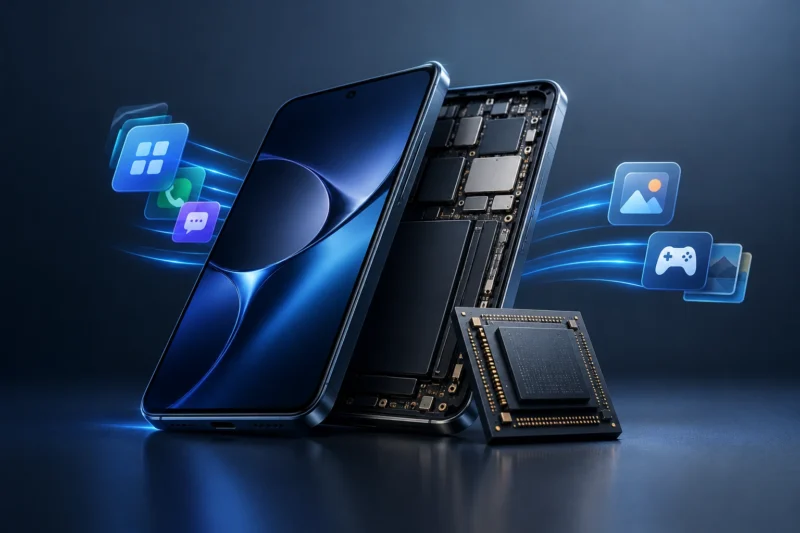
UFS matters because it sits underneath a lot of the stuff people notice without thinking about it. Opening large files. Switching between apps. Booting the phone. Saving photos. Loading games. Even those tiny pauses where a device seems to hesitate for a second — those can all be shaped by the storage layer working behind the scenes.
So when people say a phone feels responsive, they’re not only talking about the processor or RAM. UFS helps decide whether the device feels quick and clean or a little sticky around the edges. That’s why the difference between UFS 4.0 vs UFS 3.1 is more than a spec-sheet argument. It’s about the everyday feel of the phone in your hand.
And yes, it’s worth looking at UFS alongside RAM when you’re comparing phones. RAM helps with multitasking, but storage is part of what keeps apps launching fast and files moving without drama. If either one is weak, the phone can feel slower than you expected, even if it looks good on paper.
Why slow phones are often really storage problems
When a phone starts feeling old, most people assume the problem is age. Sometimes it is. But very often, it’s the storage system being pushed too hard. That’s why UFS and RAM specifications matter more than many buyers realize. A device may still have a decent processor, but if storage is dragging, the whole experience can still feel behind.
This is also why some phones seem fine for a while and then start feeling cramped. As apps get larger and files get heavier, the storage layer has more work to do. That’s when a faster standard can make a real difference, even if the change sounds invisible at first.
What UFS 4.0 adds beyond the older standard
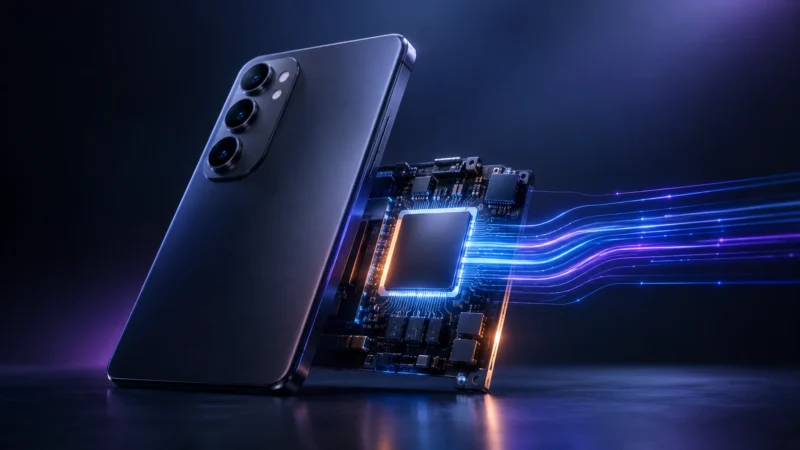
UFS 4.0 arrived in August 2022, and it’s easy to see why people talk about it as a meaningful jump rather than a small revision. The big headline is speed, sure, but the upgrade also touches thermal handling, storage capacity, and the way the phone deals with heavy workloads. In other words, it’s not just about moving data faster. It’s about doing more of it without the device feeling strained.
There’s a nice practical side to that. UFS 4.0 isn’t only built for benchmark bragging rights. It’s designed for smoother gaming, better handling of high-resolution video, and faster work with big files. If you record a lot of video or move a lot of media around, that extra headroom starts to matter pretty quickly.
The newer standard also raises the ceiling to 1TB, which gives manufacturers more room to build phones that can hold a lot without immediately feeling cramped. For people who keep huge photo libraries, offline media, or a bunch of games installed, that’s not a tiny detail.
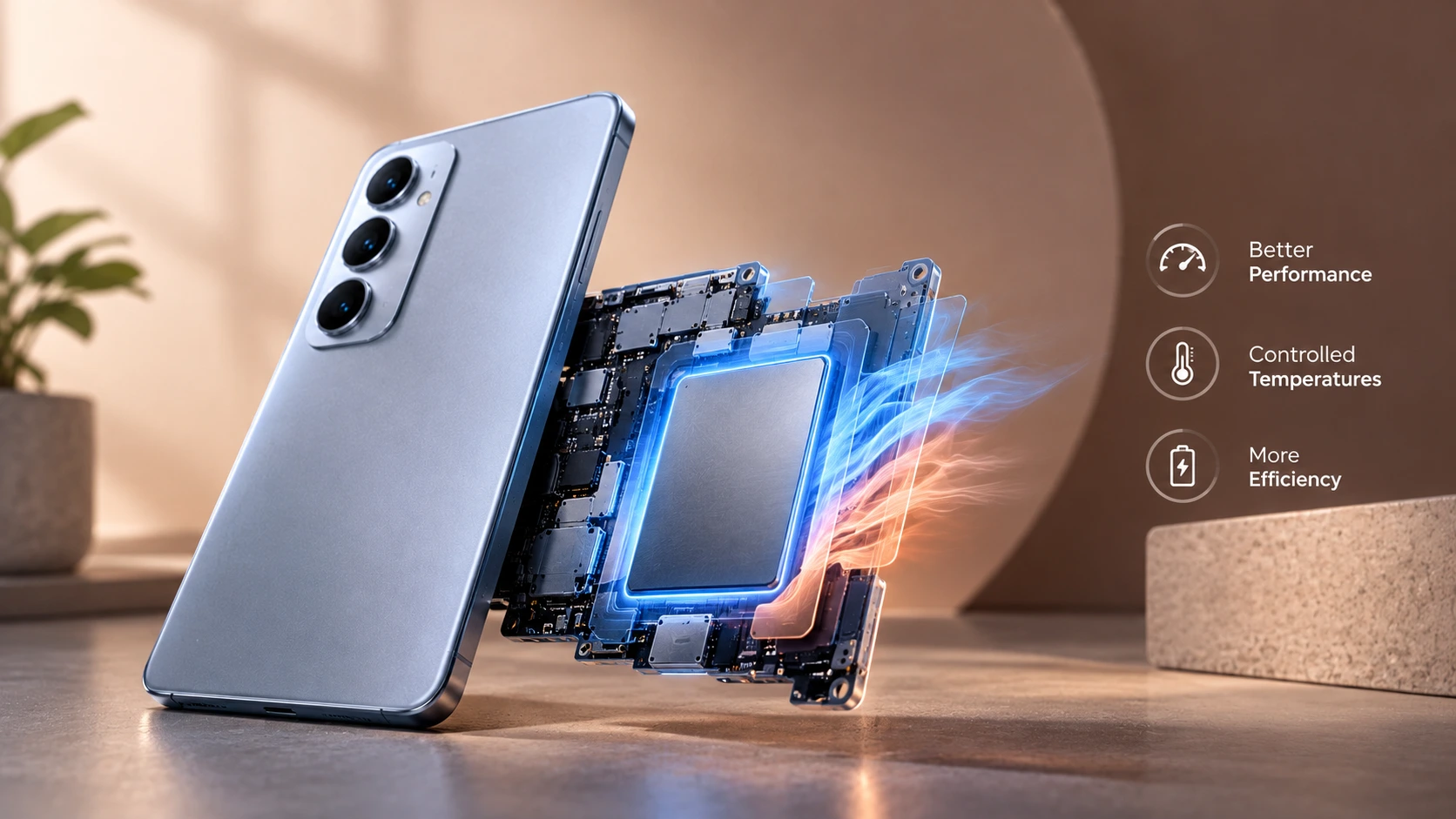
Here’s the thing: UFS 4.0’s improvements are spread across several areas at once, which is why it feels like such a strong step up. Speed is the obvious one, but thermal behavior and efficiency are part of the story too. When a phone stays steadier under load, the performance tends to feel more consistent.
- Released in August 2022
- Maximum data transfer speed up to 23 Gbps
- Up to 1TB file storage
- Upgraded MIPI physical layer
- Advanced thermal features
- File-Based Optimisation for heavy-load files and high-resolution video recording
Where UFS 4.0 feels faster in real use
This is where the spec starts turning into a feeling. UFS 4.0 tends to show its strength when you’re launching apps, moving larger files, or doing things that ask the storage to work hard for a few seconds in a row. That can mean faster loading screens, less waiting when you open big media files, and fewer little pauses during busier moments.
Gaming is a good example. The game itself may depend on the chip and graphics system, but storage still plays a role when textures, levels, and data need to be loaded. Faster storage doesn’t magically make every game run like a console, but it does help reduce friction. And friction is what people notice.
So when people talk about UFS 4.0 storage speed, they’re really talking about how much smoother the phone behaves when the workload spikes. It’s less about a dramatic one-second miracle and more about a bunch of small wins that add up.
What UFS 3.1 still does well, even after UFS 4.0 arrived
UFS 3.1 was the long-running flagship standard before UFS 4.0 took over the spotlight, and it’s still more capable than many casual buyers give it credit for. It’s not the exciting new thing anymore, but that doesn’t make it weak. For normal mobile use, it remains a very good fit.
That matters because not every phone user is pushing huge video files or heavy games all day. If you mostly text, browse, stream, take photos, and bounce between a handful of apps, UFS 3.1 can still feel fast enough. The older standard is not some leftover piece of tech that suddenly stopped being useful.
Its strengths are practical, not flashy. Write Boost with advanced SLC cache technology helps with faster writing behavior, and DeepSleep helps reduce power use by switching off some background activity. That’s a pretty sensible combination for phones that need to stay responsive without draining the battery too aggressively.
It also supports higher-resolution video like 4K and 8K, which is part of why it held the market so strongly for a while. In other words, UFS 3.1 still does the everyday jobs well. It just doesn’t push as far as the newer standard when the workload gets more intense.
- Write Boost with advanced SLC cache technology
- DeepSleep power efficiency
- Data transfer rate around 11 Gbps
- Support for 4K and 8K video
Why the UFS 3.1 write boost and DeepSleep features still matter
The Write Boost feature helps speed up the parts of storage activity that involve writing data, which can make app launching and file loading feel a little more immediate. That’s useful because many of the annoying slowdowns on a phone happen when it’s trying to save or move data, not just read it.
DeepSleep is the quieter feature, but it’s important too. Think of it like a smarter rest mode for parts of the storage system. By turning off some background activity, the phone can save power and help manage heat more efficiently. That can make the phone feel steadier over longer sessions.
So, while UFS 3.1 may not headline the newest charts, it still gives you a balanced mix of speed and battery-friendly behavior. For a lot of users, that’s enough.
UFS 4.0 vs UFS 3.1 side by side
This is where the differences get easier to see at a glance. A side-by-side comparison makes it clear that UFS 4.0 doesn’t just inch ahead of UFS 3.1. It stretches the gap in the areas that matter most: transfer speed, write speed, capacity, and efficiency.

| Comparison point | UFS 4.0 | UFS 3.1 |
|---|---|---|
| Data transfer speed | 23 Gbps | 11 Gbps |
| Maximum write speed | 6 Gbps | 2.5 Gbps |
| Storage capacity | Up to 1TB | Up to 512GB |
| Power efficiency | 46% more than UFS 3.1 | Standard power efficiency |
| DeepSleep feature | Yes | Yes |
| Data transfer protocol | 2-lane | 2-lane |
The strongest contrast is that UFS 4.0 nearly doubles transfer speed while also improving write speed, capacity, and efficiency. That’s a pretty broad upgrade. The one area where both standards line up is the 2-lane transfer protocol and DeepSleep support, which means the newer version isn’t changing absolutely everything — it’s just improving the parts that most affect performance.
Which numbers actually separate the two standards
If you want the short version, the clearest gaps are 23 Gbps versus 11 Gbps, 6 Gbps versus 2.5 Gbps, and 1TB versus 512GB. Those are the numbers that signal a real move forward rather than a tiny tuning change.
The 46% power-efficiency gain is probably the most important battery-related detail here. It doesn’t mean your phone suddenly lasts forever, of course, but it does mean the storage system can do its work with less energy wasted. And when you’re trying to stretch a battery through a long day, little gains like that matter morethan people think.
Which one makes more sense for your phone
The honest answer is that UFS 4.0 makes more sense if you care about speed, multitasking, gaming, video work, or just having a phone that feels a bit more effortless. It’s the better choice for heavier users and for anyone who wants some breathing room for the future.
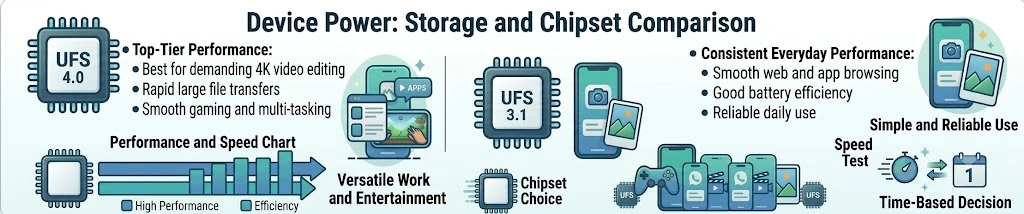
UFS 3.1 still makes sense for plenty of people, especially if your daily use is pretty ordinary. If you don’t move giant files often, don’t play demanding games, and don’t worry much about top-tier storage performance, it’ll still feel good. That’s the nuance here. Not every phone needs the newest storage to feel fine.
But if you’re choosing between two devices and one has UFS 4.0 while the other has UFS 3.1, the newer standard gives you more headroom. That’s especially true if you keep your phones for years. Today’s “good enough” can feel a lot less good once apps get heavier and your usage grows.
It’s also worth remembering that UFS 4.1 arrived in January 2025 with even better features than UFS 4.0, which shows how quickly this part of phone hardware keeps moving. So if you’re buying now, the storage spec is one of those details that quietly says a lot about where a phone sits in the product cycle.
FAQ
These are the questions people usually ask after they’ve looked at the numbers and still want the practical answer for real life.
Q: Is UFS 4.0 better than UFS 3.1?
Yes. UFS 4.0 is better than UFS 3.1 in the areas most people care about: speed, efficiency, and storage headroom. The big reasons are the higher transfer speed, the 46% power-efficiency improvement, and the larger supported capacity.
Q: When was UFS 4.0 released?
UFS 4.0 was released in August 2022.
Q: What is the latest version of UFS?
UFS 4.1 is the latest version mentioned here, and it was released in January 2025.
Q: When was UFS 3.0 released?
UFS 3.0 was released around January 2020.
Conclusion
If you want the clearest takeaway, UFS 4.0 is the stronger option for everyday phone performance. It’s faster, more efficient, and better suited to heavier tasks, which is exactly why it tends to make a phone feel more responsive in daily use. UFS 3.1 still does a perfectly respectable job, but it’s the older balance point, not the newer one.
So if you’re buying or upgrading a phone, the real question is whether you want the extra headroom now. If you do, UFS 4.0 is the better bet. If your usage is lighter and you’re fine with solid baseline behavior, UFS 3.1 can still hold up well. Either way, storage isn’t just background hardware anymore. It’s part of the feel of the phone.